Garment supply chains combine high product variety with short selling windows. A single collection may include many styles, colours and sizes, each with its own material specifications, supplier dependencies, and production requirements. Even a small design change can affect fabric availability, marker efficiency, cutting plans, line loading and delivery commitments.
The challenge becomes greater when materials are sourced globally, production is split across owned factories and contract manufacturers, and orders must reach multiple retail and e-commerce destinations within tight delivery windows. Minimum order quantities, long supplier lead times, variable yields, labor constraints, and quality issues add further uncertainty.
Integrated planning connects commercial demand with material availability, production plans, capacity constraints, and distribution requirements. Instead of treating each function as a separate planning exercise, it enables teams to assess trade-offs across the value chain and align decisions to shared business priorities.
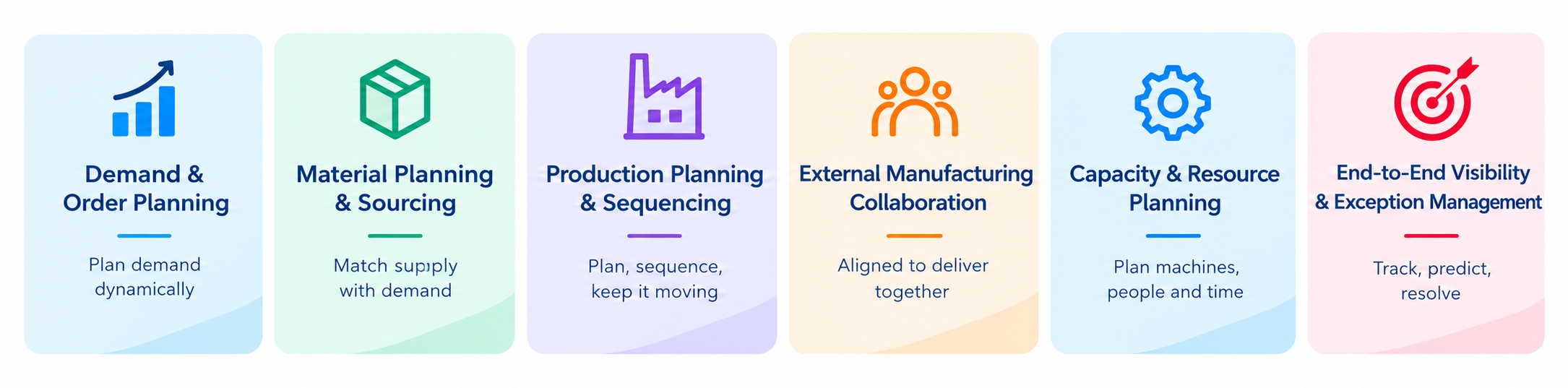
1. Connect demand and order planning
Build a demand view by style, colour and size, incorporating seasonal plans, retail and e-commerce orders, and changes in customer priorities. Scenario planning helps teams assess the implications of demand shifts before they become urgent execution issues.
2. Align material planning and sourcing
Translate the product bill of materials into time-phased fabric, trim, and accessory requirements. Compare these needs with supplier lead times, minimum order quantities, available inventory, and committed receipts. When a constraint appears, planners can evaluate alternate materials, purchase options, or allocation decisions earlier.
3. Synchronise production planning and sequencing
Coordinate dyeing, printing, cutting, sewing, and finishing with line capacity, labor availability, changeovers, and bottlenecks. A connected plan makes it easier to evaluate sequence changes, identify work-in-progress risks and understand how one production decision affects downstream operations.
4. Collaborate with external manufacturers
Bring contract manufacturers into the planning conversation through shared views of capacity, material readiness, work in progress and delivery commitments. Comparing vendors on cost, lead time and available capacity supports more informed sourcing and allocation decisions.
5. Improve visibility and exception management
Track material production, shipment status, and delivery risks against the plan. Alerts and scenario comparisons help planners focus on the exceptions that matter most, assess options, and agree on corrective actions before service or margin is affected.
FROM BETTER PLANS TO MEASURABLE BUSINESS OUTCOMES
A connected planning approach can help garment manufacturers work towards stronger on-time delivery, lower excess inventory, better utilisation of machines and labor, shorter response times, and improved profitability. It can also support a more resilient supply chain by making dependencies visible and enabling teams to prepare for disruption.
These outcomes depend on the quality of the underlying data, the planning processes adopted, the discipline of cross-functional collaboration and the organisation’s ability to act on insights. Technology enables change, but sustained value comes from connecting planning decisions to day-to-day execution.
START WITH THE DECISIONS THAT MATTER MOST
Manufacturers do not need to transform every planning process at once. A practical starting point is to identify the most costly or frequent planning challenges—such as material shortages, missed seasonal deliveries, factory capacity imbalances, or poor visibility across external manufacturing. From there, teams can prioritise data readiness, define decision ownership, establish measurable outcomes, and build an implementation roadmap.
The goal is not simply to produce another forecast or schedule. It is to help demand, sourcing, manufacturing, and distribution teams work from a shared plan, understand the trade-offs, and respond to change together.
BUILDING A MORE RESILIENT GARMENT BUSINESS
The garment supply chain will always be dynamic, shaped by changing consumer trends, global sourcing, and multiple dependencies. However, an integrated planning approach across demand, materials, production, capacity, and distribution can help manufacturers reduce uncertainty, improve service levels, and make faster, more profitable decisions.
By connecting data, people and processes across the value chain, garment manufacturers can move from reactive firefighting to proactive, data-driven planning—and build a more resilient business that is ready for what comes next.
